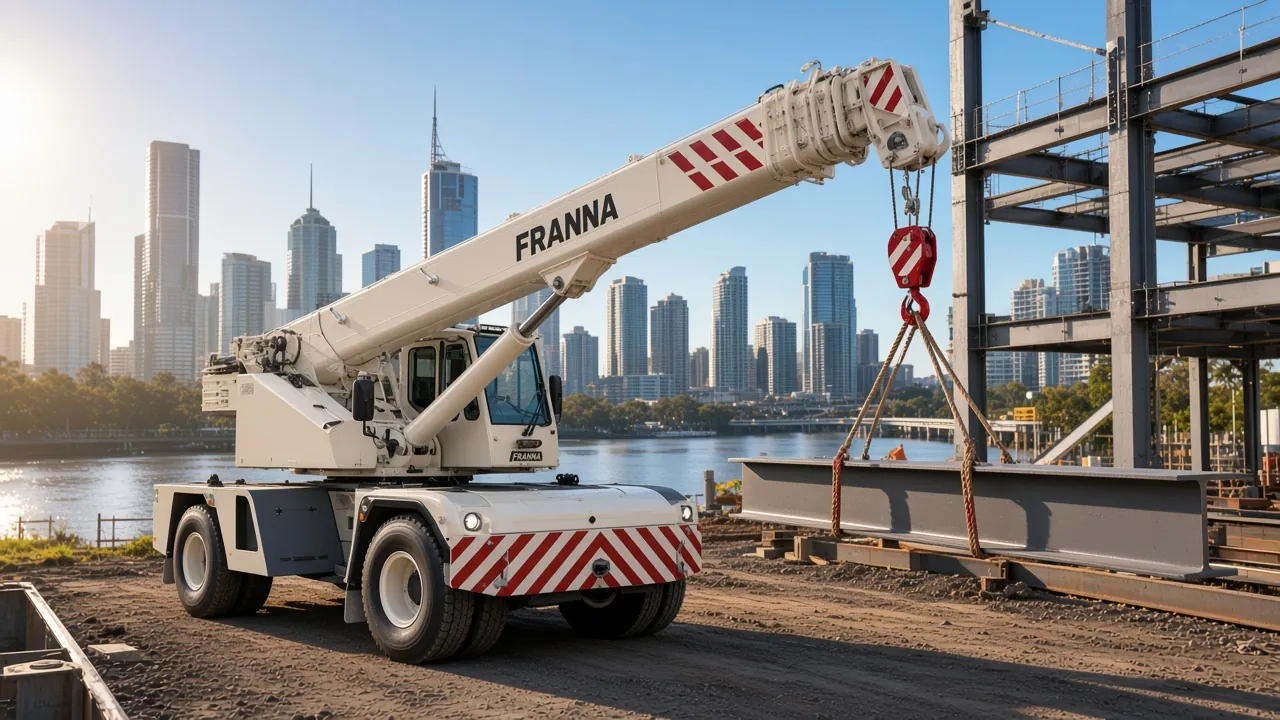
Tell us your suburb, what needs lifting and roughly how heavy it is. We work out the right pick-and-carry crane for your street, driveway or yard, send a clear written quote, and book an operated Franna for the day you need, weekdays, nights or weekends.
Crane hire that starts with your street
Every Brisbane lift is shaped by where it happens. A container drop in a Wacol yard, a pool shell going over a house in Carindale, a steel beam into a Queenslander in Paddington and a generator into a warehouse at Eagle Farm all need a crane, but each needs a different plan. The weight is only part of it. The street width, the driveway slope, the powerlines out the front, the trees, the ground and the council rules for your area all decide which crane can do the job and how.
That is why we ask about the site first. Once we know the suburb and the access, we can tell you whether a pick-and-carry crane suits, which class makes sense and what has to be arranged before the day. You get one clear quote, not a list of maybes.
What locals book a Franna for
- Containers: dropping, moving and loading shipping containers on homes, farms, depots and yards. See container crane hire.
- Building and renovation steel: beams, posts, frames and trusses for home renovations, extensions and new builds. See steel erection.
- Pools and spas: fibreglass pool shells and spa baths lifted into backyards. See pool and spa lifts.
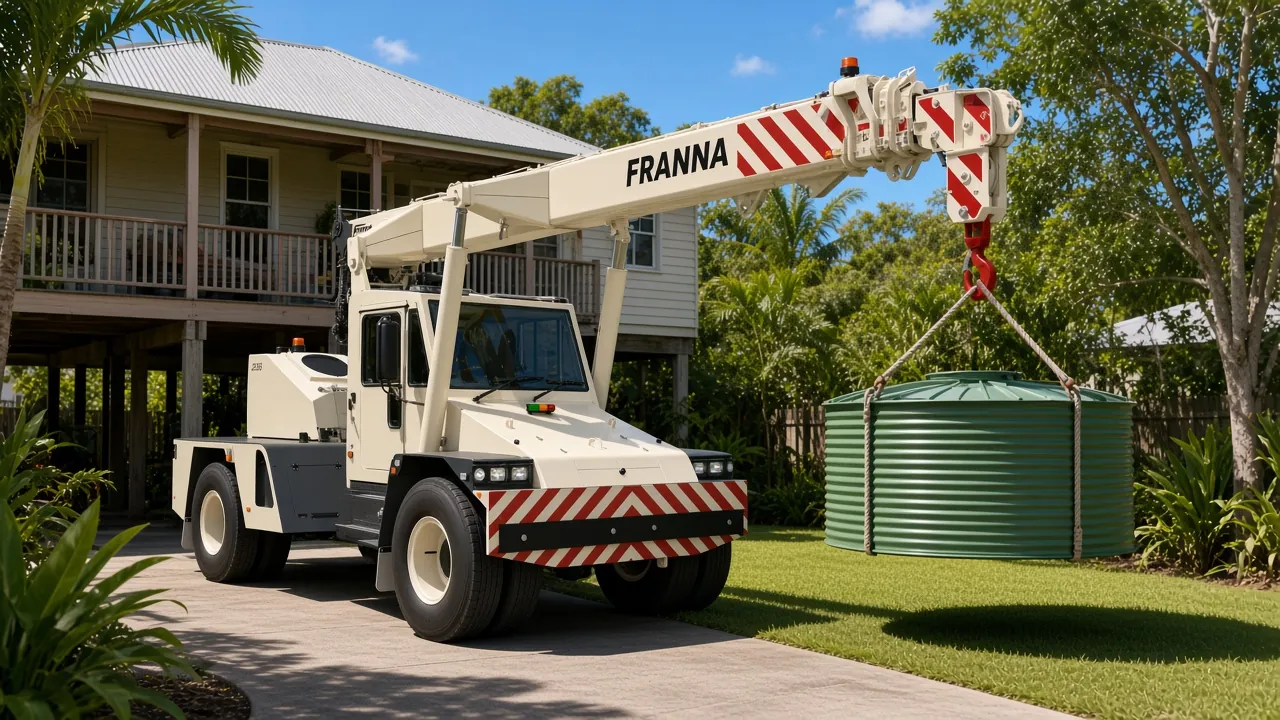
- Water tanks: poly and steel tanks placed beside homes, sheds and farm buildings. See water tank lifts.
- Roofing and materials: packs of roofing sheets, trusses and materials lifted onto roofs and upper floors. See roofing and materials lifts.
- Boats: trailer boats, tenders and small craft lifted at homes, ramps and hardstands. See marine and boat lifts.
Suburbs and regions we cover
We take bookings right across Greater Brisbane and down to the Gold Coast and up to the Sunshine Coast. Our area pages give local notes on access, typical jobs and the council that looks after your street.
- Brisbane northside: Chermside, Aspley, Brendale, Strathpine, North Lakes and the Moreton Bay suburbs
- Brisbane southside: Mount Gravatt, Sunnybank, Acacia Ridge, Rocklea, Logan and Redlands
- Ipswich and the western corridor: Wacol, Darra, Springfield, Ripley and Ipswich
- Gold Coast: Yatala to Coolangatta, canal estates and the hinterland
- Sunshine Coast: Caloundra to Noosa and the hinterland towns
Industrial hubs with heavy crane demand have their own pages too: Eagle Farm, Acacia Ridge, Wacol, Yatala and Kunda Park.
Who we lift for
Our industry pages explain how Franna lifts fit different kinds of work:
Licensed and insured operators
Every booking is operated hire. Your operator turns up holding the Queensland high risk work licence that matches the machine, and the whole hire is covered by insurance. When a lift needs a dogman or rigger, licensed crew are listed on your quote, so you know who is coming and what they are doing before the day.
Nights, early starts and weekends
Brisbane traffic, school zones and busy shopping strips mean a lot of crane work is better done outside peak times. We take after-hours and weekend bookings for road-closure lifts, retail and commercial roofs, school jobs and builders who need a Saturday lift to stay on programme. If council approval or traffic control is needed, the earlier you book, the easier it is to line everything up.
How it works
- Send the job. Suburb, what it is, roughly how heavy, where it has to go, and photos of the entry and the spot where the crane would park.
- We plan it. We match the crane class to the load and reach, check the access and flag any permits, powerlines or ground issues.
- You approve a written quote. It lists the crane, the crew and what is included. Nothing is booked until you say yes.
- Lift day. The operator checks the site, runs the pre-lift checks and gets the job done.
The local checks we make before quoting
- Council and road rules: whether the job needs kerbside or footpath space, and which council or road authority signs off on it
- Powerlines: most Brisbane streets have overhead lines, and Queensland sets exclusion zones for cranes
- Driveways and slopes: steep and narrow driveways are common in hilly suburbs and the hinterland
- Ground: clay soils, new fill in fresh estates and sandy coastal ground all behave differently under a crane
- Trees and awnings: street trees, carports and verandahs often decide where the boom can go
Our local guides cover these in detail, including crane permits in Brisbane and powerline exclusion zones.
Why a pick-and-carry crane suits so many local jobs
A Franna is an articulated pick-and-carry crane. It bends in the middle to steer, carries its boom on the front section, and is designed to lift a load on its wheels and drive with it. For the kinds of lifts that fill a typical week in South East Queensland, that design solves a lot of problems at once.
Most suburban and industrial lifts are not about raw tonnage. They are about getting a load from the back of a truck to a spot the truck cannot reach: behind a house, into a shed, across a yard, onto a slab or into an excavation. A slewing crane can do that if it can be set up within reach, but every new position means packing up and re-setting outriggers. A pick-and-carry crane can usually lift, walk the load to where it is going and set it down, then come back for the next one.
That matters on streets where there is no room for outriggers, on industrial sites where the work moves from one bay to the next, and on jobs where the crane only needs to be there for a short time. It is also why a Franna is often the first crane people think of for containers, steel, tanks, pools and plant.
When we will suggest something else
A pick-and-carry crane is not always the right answer, and we would rather say so than send the wrong machine. Very heavy loads at long reach, lifts high over buildings, and sites where the crane can only stand a long way from the set-down point often suit a slewing all-terrain crane or a different approach. Light deliveries that only need to come off the truck beside where it parks can sometimes be done by a crane truck in one trip. If your job falls into one of those categories, we will tell you before you book.
Lifts in the suburbs: what usually decides the job
Every suburb has its own pattern, but the same five questions come up in almost every residential lift we plan.
- Where can the crane stand? On the driveway, on the verge, on the road, or not at all? The closer the crane can get, the smaller it can be.
- What is overhead? Street powerlines, the service line to the house, trees, carports and verandahs all limit where the boom and load can go.
- What is under the crane's path? Concrete driveways are generally fine. Pavers, thin slabs, lawns, septic tanks, stormwater pits and pool shells are not built to carry a crane.
- How steep is it? Pick-and-carry cranes work to load charts based on level ground. Steep driveways and cross-falls reduce what can be carried safely.
- Does the crane need the street? If so, council approval and traffic control may be needed, and the lift has to fit the approved times.
Send us photos that answer those questions and you will get a far more accurate quote, far sooner.
Lifts on industrial estates
Industrial sites are usually easier for a pick-and-carry crane than homes. Hardstand yards, wide gates and concrete floors suit the machine well. The questions on these sites are more about the load and the operation around it: how heavy is the machine or container, where are the lifting points, what else is moving in the yard, and when can the lift happen without stopping work.
On busy estates such as the TradeCoast, Acacia Ridge, Wacol, Yatala and Kunda Park, many businesses prefer lifts before opening, after close or during a shutdown. Forklifts, trucks and staff need to be kept clear of the travel path while the crane is carrying a load, so a short pre-lift briefing with the site supervisor is part of the plan.
Weather in South East Queensland
Our climate shapes crane work more than people expect. The storm season, roughly from late spring through summer, brings afternoon storms with strong gusts and heavy rain. Long or light loads with a large surface area, such as roofing packs, water tanks, pool shells, signs and steel frames, catch wind easily. Operators monitor wind during the lift and will pause or stop if gusts exceed safe limits for the load and crane configuration.
Rain matters for a different reason. Clay soils common across Brisbane, Ipswich and Logan soften after heavy rain, and freshly filled ground on new estates can lose strength quickly. A site that is fine in a dry week may not carry a crane after a storm. If it has rained heavily before your lift, tell us about any soft areas, and plan morning lifts in storm season where you can.
Rules that affect when lifts can happen
- Building work noise: in Queensland, noisy building work is generally limited to 6:30am to 6:30pm Monday to Saturday, and not on Sundays or public holidays. Some lifts are exempt or have approvals for other times, but residential lifts are usually planned inside those hours.
- School zones: many Queensland school zones operate in the morning and afternoon drop-off and pick-up times. A crane that needs the road near a school is better scheduled outside them.
- Road and footpath approvals: councils set the hours a crane can occupy a road or footpath. On busy roads, that is often nights or weekends only.
- Airport airspace: sites near Brisbane, Archerfield, Gold Coast and Sunshine Coast airports can have limits on crane height, and a crane that would penetrate protected airspace needs approval.
What a written quote from us includes
Your quote lists the crane class we recommend and why, the operator and any dogman or rigging crew, how hire time is counted, any minimum, and the items that depend on your site, such as traffic control, council approvals or ground protection. If something is uncertain, such as an unconfirmed load weight, the quote says so and explains what we need to confirm it. Nothing is booked until you approve it.
Planning a lift with your builder, pool company or supplier
Many lifts involve more than one business. The pool company delivers the shell, the steel fabricator delivers the beams, the container company brings the container, and the builder or installer finishes the job. The crane sits in the middle, so timing matters. A delivery that arrives an hour after the crane is booked costs everyone time.
- Share the crane booking time with the delivery company and ask for a confirmed delivery window.
- Make sure the people who will receive the load, such as installers on the roof or in the excavation, are on site and ready.
- Have the paperwork ready: delivery dockets with weights, manufacturer lifting instructions and site induction details.
- Tell us who the on-site contact is and give us their mobile number.
Getting the most from your booking
- Group lifts into one visit where you can. Two or three lifts on the same day is usually far more efficient than separate bookings.
- Clear cars, bins, trailers and materials from the crane's path the night before.
- Disconnect, drain and unbolt plant before the crane arrives.
- Keep children, pets and spectators well clear of the lift area.
- If something changes, such as a delivery delay or wet ground, call as early as possible so the booking can be adjusted.
Common jobs, step by step
A container to the back of a suburban block
The container company delivers on a tilt tray or a truck, but the container has to go behind the house where there is a single driveway and a carport. The crane sets up on the driveway or the street, lifts the container from the truck with chains on the corner castings and a spreader, and either carries it down the driveway if the ground and width allow, or lifts it over the fence to footings prepared at the back. The things that decide the crane are the distance from the crane to the footings, the overhead lines and the driveway surface.
A steel beam into a renovation
The builder has removed a wall and needs a long steel beam set on new posts. The beam arrives on the fabricator's truck. The crane lifts it off, carries it close to the ground to the house and presents it through an opening, while the builder's crew guides it in. The crane holds the beam while temporary props or the posts take the load, and releases only when the crew says it is secure.
Machinery into a factory unit
A business has bought a new machine, delivered on a semi-trailer. The crane lifts it off the trailer using the manufacturer's lifting points, carries it through the roller door and lowers it onto skates or its footings. The checks beforehand are the machine weight, the door size, the floor and the clear height inside.
A pool shell over the house
The excavation is dug and the pool company has the shell on a truck in the street. The crane stands on the road or driveway, lifts the shell with a spreader at its lifting points, takes it over the roof or down the side and lowers it into the hole while the installers guide it. Wind, height and reach are the deciding factors.
Frequently overlooked details
- Rigging weight counts. Spreader bars, slings, chains and shackles all count against the crane's capacity.
- The hook needs room. The boom and hook block need clearance above the load, which matters under carports and inside sheds.
- Loads swing. Tag lines and a clear area around the lift are essential.
- Cranes need to leave. Plan the exit route as well as the way in.
- Paperwork takes time. Inductions, permits and traffic plans should be sorted well before the day.
Questions to ask any crane hire booking
Whoever you book with, these questions tell you whether the quote matches the job:
- Which crane class is quoted, and why? A recommendation should be tied to your load weight, the reach and the site.
- Is the operator licensed for that crane? In Queensland, pick-and-carry cranes need the non-slewing mobile crane licence.
- Is a dogman or rigger included, and is one needed? Lifts where the operator cannot see the load need one.
- How is hire time counted? From the yard, from arrival on site, and what is the minimum?
- What is not included? Traffic control, permits, mats and specialist rigging are common extras on other quotes.
- What happens if the weather turns? Ask how postponements are handled.
Our written quotes answer all six up front, so you can compare them like for like.
A note on the name
Franna is a registered trademark for a brand of articulated pick-and-carry crane. Across Queensland, people use the name for any crane of that style, the same way they might say Hiab for a truck crane. We use it in that everyday sense. The cranes booked through this site are operated pick-and-carry cranes matched to your lift, and this site has no connection with the trademark owner.
Ready to book?
Send the suburb, the item, its rough weight and a few photos of the street and the spot it needs to go. That is enough for us to tell you which crane class fits and what the lift will involve.
Questions Brisbane customers ask
How much does it cost to hire a Franna in Brisbane?
The number comes from the machine size, the hours, the drive to your suburb, the crew, the day and time, and any permits. We do not publish set prices; we send a written quote for your actual job.
Do you cover my suburb?
Bookings are taken from Caboolture to Coolangatta and up to Noosa. If you are on the edge of those areas, send the details and we will confirm.
Can you do a lift on a Saturday?
Yes. We take weekend and after-hours bookings.
Are your operators licensed and insured?
Yes. Yes. Every operator carries the right Queensland high risk work licence for the machine, and every hire is insured.
What should I send for a quote?
Your suburb, what needs lifting, its approximate weight and size, where it needs to go and photos of the access.
Can you lift a container into my backyard?
Often, yes. It depends on the container size, how close the crane can get and what is between the street and the set-down point. Photos help us check.
Do you lift on Sundays?
Weekend lifts are available, but noise rules generally limit building work on Sundays and public holidays in residential areas. We will advise what is possible for your site.
What if it storms on the day?
The operator will pause or postpone the lift if wind or ground conditions become unsafe. We will work with you to rebook.
Can you hold a beam while the builder fixes it?
Yes. The crane holds the load until the crew confirms it is secure.
Do I need a dogman for a pool lift?
Often, because the operator may not see the excavation. We confirm crew on the quote.
Where is the lift and what is it?
Tell us the suburb, what needs lifting and roughly how heavy it is. Add photos of the site entry and where the crane would park, and we will come back with a clear written quote.
- Licensed and insured crane operators
- After-hours and weekend lifts available
- Brisbane, Gold Coast and Sunshine Coast
- No obligation – you approve before anything is booked
Prefer email? info@brisbanefrannacranehire.com.au
Request Received
Thanks ! Someone from Brisbane Franna Crane Hire will call you back shortly. For emergencies right now, please call us directly.
Call 07 3106 1834